| | | | | | | Presented By the Carnegie Endowment for International Peace | | | | Axios World | | By Dave Lawler ·Sep 28, 2020 | | Welcome back to Axios World. Hope you had a lovely weekend. - Tonight's journey (1,621 words, 6 minutes) covers COVID, the Caucasus, cardinals and more.
- Heads up: "Axios on HBO" is back tonight at 11 pm ET/PT on all HBO platforms. Tonight's episode features an interview of Bob Woodward by Axios' Jonathan Swan.
Not yet signed up? Change that here. | | | | | | 1 big thing: 1 million deaths |  Data: Our World in Data; Chart: Sara Wise/Axios The global toll of confirmed deaths from COVID-19 is on the cusp of 1 million this evening, according to data from Johns Hopkins. By the numbers: More than half of those deaths have come in four countries: the U.S. (204,995), Brazil (141,741), India (95,542) and Mexico (76,430). The true global death toll is likely far higher. - Adjusted for population, Peru, Belgium, Bolivia, Spain and Brazil have had the world's deadliest outbreaks to date. The U.S. is eighth and Mexico is 10th.
How we got to 1 million: The first known death from COVID-19 was announced on Jan. 11 in Wuhan, China, where the pandemic began. - By the end of February, several countries — South Korea, Iran, Italy — had outbreaks, but just 104 deaths had been recorded outside of China.
- Europe became a new epicenter by early March. Italy instituted the first nationwide lockdown on March 9, and much of Europe and the world soon followed.
- The highest daily global death tolls came in mid-April when the pandemic was near its peak in western Europe and in parts of the U.S., including New York City.
- By early May, the situation was improving in Europe but the U.S. continued to record upward of 1,000 deaths each day. Latin America, meanwhile, was becoming a new global epicenter.
- Since the spring, more than half of all deaths recorded globally have come in the Americas, though India has joined the U.S., Brazil and Mexico among the countries recording the highest death tolls.
The state of play: India is approaching 100,000 deaths. It's currently tallying the world's highest daily totals, followed by the U.S. and Brazil. - European countries including Spain and France are dealing with severe spikes, with cases exceeding the numbers recorded in the spring but deaths lagging behind (though ticking upward).
- The pandemic continues to be far less deadly in Africa, though testing is limited in many countries. One oft-cited reason is the continent's very young population.
The true death toll from COVID-19 will never be known with any precision, but "excess mortality" figures indicate that the U.S. is probably undercounting deaths by about 30% — and many other countries by more than that, per the Economist. - Mike Ryan, emergencies director at the WHO, recently warned that the official death toll could double to 2 million before a vaccine is widely available.
The trend: Every day, approximately 5,300 coronavirus deaths are being recorded around the world — a number that has held relatively steady since July (based on seven-day rolling averages). At that rate, we should expect 500,000 more deaths by the end of 2020. - The rate could still shift significantly in either direction.
Worth noting: The WHO announced today that it will distribute to low- and middle-income countries a new, cheap test that can diagnose COVID-19 in 15-30 minutes. |     | | | | | | 2. Nagorno-Karabakh: Clashes in the Caucasus | 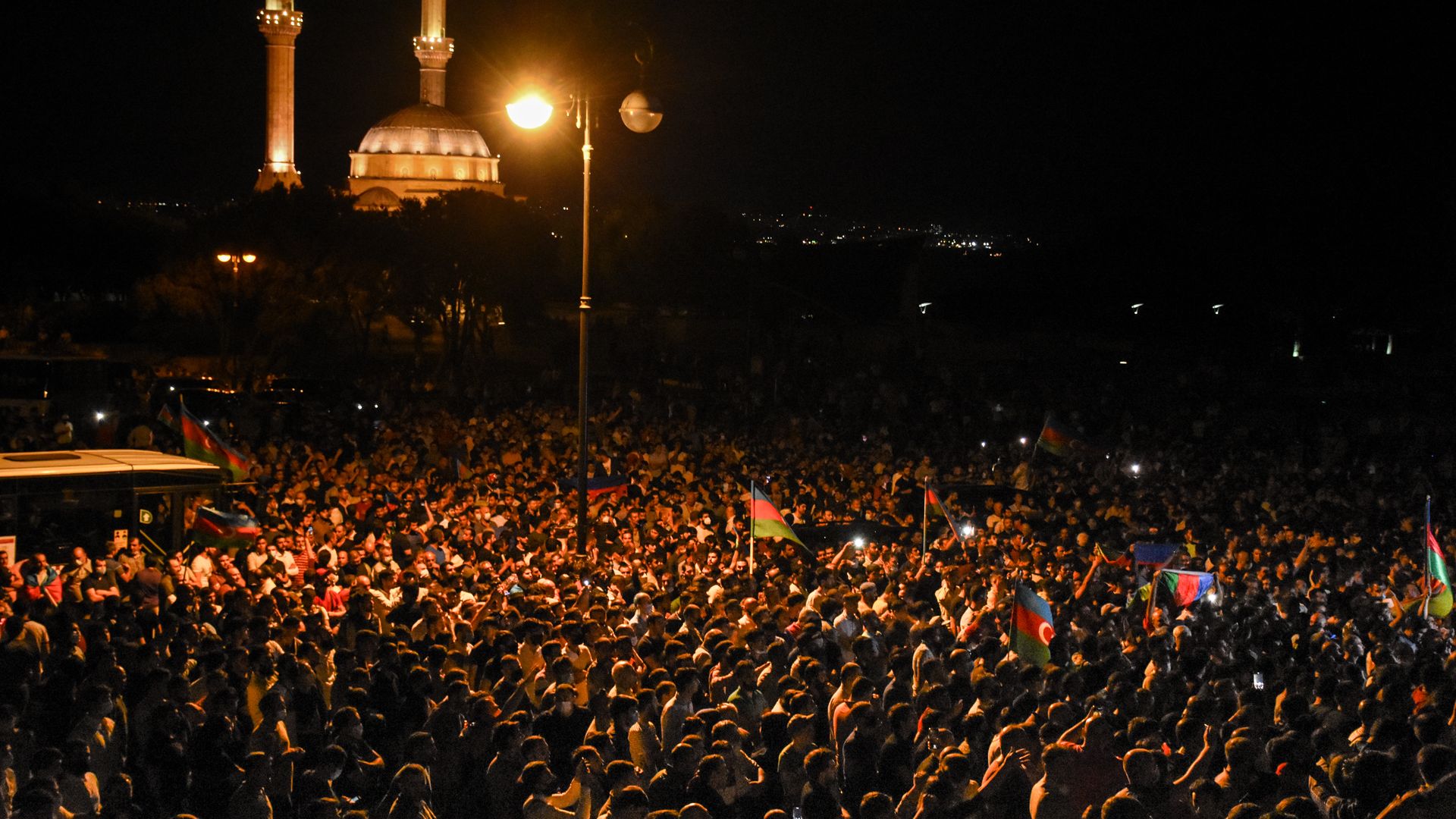 | | | Rallying around the flag in Baku, following previous clashes in July. Photo: Sahin Serdarov/Anadolu Agency via Getty Images | | | | Fighting has continued for the second day over the disputed region of Nagorno-Karabakh, with at least 59 soldiers and civilians reported dead. The backstory: The mountainous region of around 150,000 people is populated mainly by ethnic Armenians but lies within the borders of Azerbaijan. The countries have both claimed the territory since the collapse of the Soviet Union, fought a war over it from 1992-1994, and stood on the precipice of further conflict since. - The violence is the worst the region has seen since 2016, and began with coordinated air and missile attacks on Sunday from Azerbaijan, which claimed Armenian forces had been preparing an attack (Armenia denies that).
- Both sides have signaled that they are prepared for war, including by declaring martial law. Calls for calm have come from Brussels, Washington, Moscow and Tehran.
They both have powerful friends. - Turkish President Recep Tayyip Erdoğan has vowed to stand shoulder-to-shoulder with Azerbaijan, and today demanded that Armenia end its "occupation" of Nagorno-Karabakh. Armenia claims Turkey is providing Azerbaijan with weapons, including drones.
- Armenia's economy and security are heavily dependent on Russia, a fellow Orthodox Christian state. Vladimir Putin spoke yesterday with Armenia's prime minister and called for an end to the fighting. Russia's foreign minister also spoke with his Turkish counterpart.
Where things stand: Previous skirmishes, though numerous, have left the stalemate largely unaltered. So has a peace process overseen by the U.S., France and Russia. Worth noting: "According to the casualty lists so far, most of those killed hadn't even been born when the conflict first started," writes Foreign Policy's James Palmer. | | | | | | | | 3. Global news roundup | 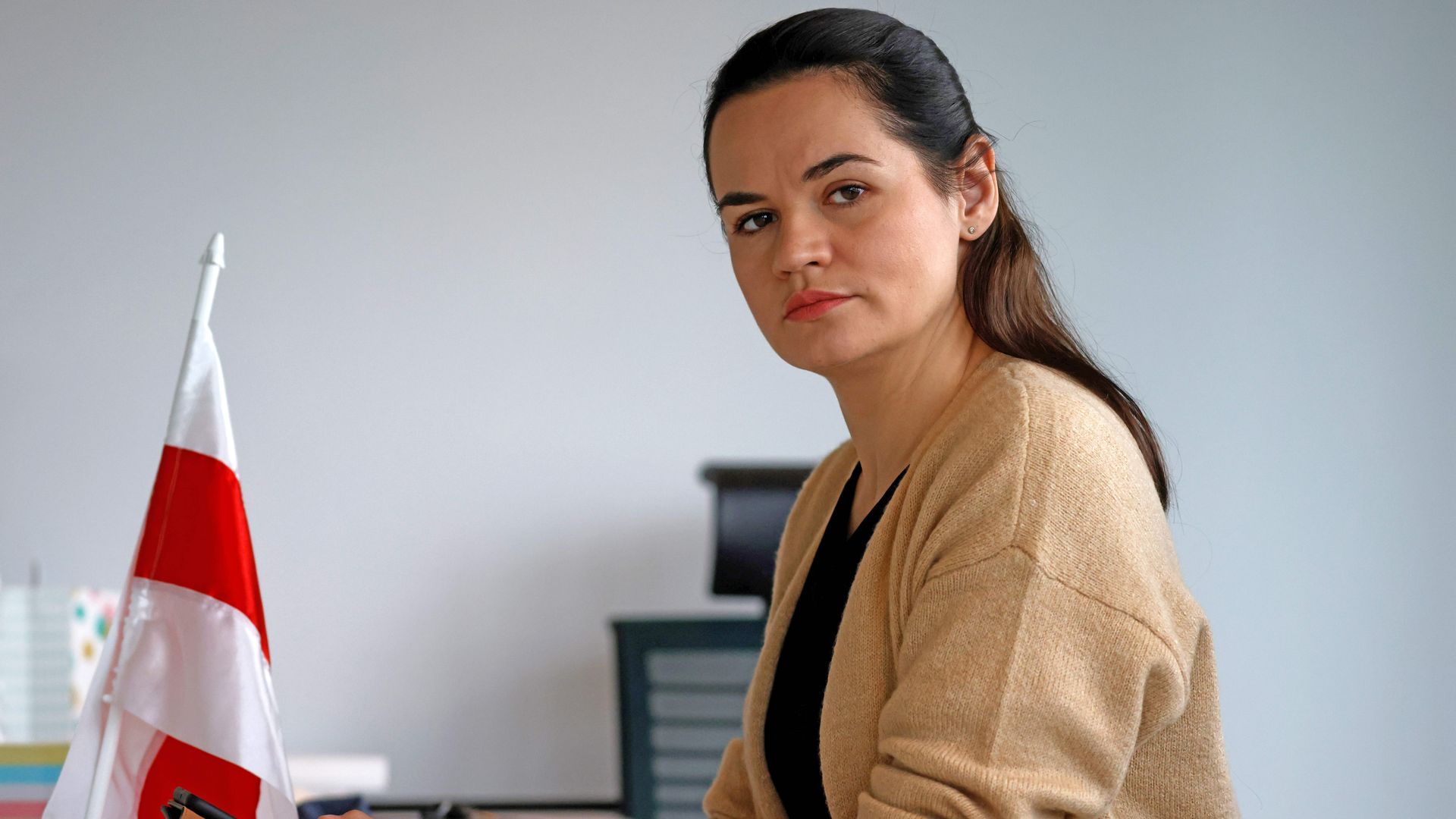 | | | The people's president? Svetlana Tikhanovskaya. Photo: Ludovic Marin/AFP via Getty Images | | | | 1. An estimated 100,000 people joined a "people's inauguration" march in Minsk on Sunday to signal that they consider opposition leader Svetlana Tikhanovskaya — and not strongman Aleksandr Lukashenko — to be their legitimate president. - French President Emmanuel Macron will meet Tikhanovskaya in Lithuania on Tuesday. She fled there following the election in August.
- The backstory: Tikhanovskaya entered the race after her husband, a popular vlogger, was arrested and barred from running. She says she'll only serve long enough to coordinate elections. Lukashenko has no intention of letting that happen.
2. Macron accused Lebanon's leaders of a "collective betrayal" on Sunday after the country's prime minister-designate withdrew. - Under Macron's initiative, Mustapha Adib had tried and failed to form a technocratic cabinet in which jobs would not simply be divvied up by political and religious factions.
- Macron accused Shiite groups in particular of thwarting those reforms, and warned Hezbollah that it should "not think it is more powerful than it is."
3. A new civilian prime minister has been appointed in Mali, meeting a condition set out by regional bloc ECOWAS for sanctions imposed following last month's military coup to be lifted. The new prime minister, Moctar Ouane, is a former foreign minister. - Bah N'Daw, a retired colonel and former defense minister, was named president of the new transitional government, with coup leader Colonel Assimi Goita slotting in as vice president.
- ECOWAS is also demanding that all prisoners taken during the coup be released, per DW. The deposed president, Ibrahim Boubacar Keita, has already been freed.
4. In a referendum on Sunday, Swiss voters overwhelmingly chose to maintain open borders with the EU. - Switzerland is not an EU member state but is deeply integrated with the bloc economically. The result was a major setback for the right-wing Swiss People's Party.
| | | | | | | | A message from the Carnegie Endowment for International Peace | | Asia is about more than just U.S.-China | | |  | | | | Beijing and Washington are fighting to set the rules in Asia. But other Asian countries are making a patchwork of their own rules, standards, and norms. Evan Feigenbaum explains how Asia's future is not Washington's or Beijing's to determine. Find out his thoughts on the future of the region. | | | | | | 4. Pope vs. Pompeo over China | 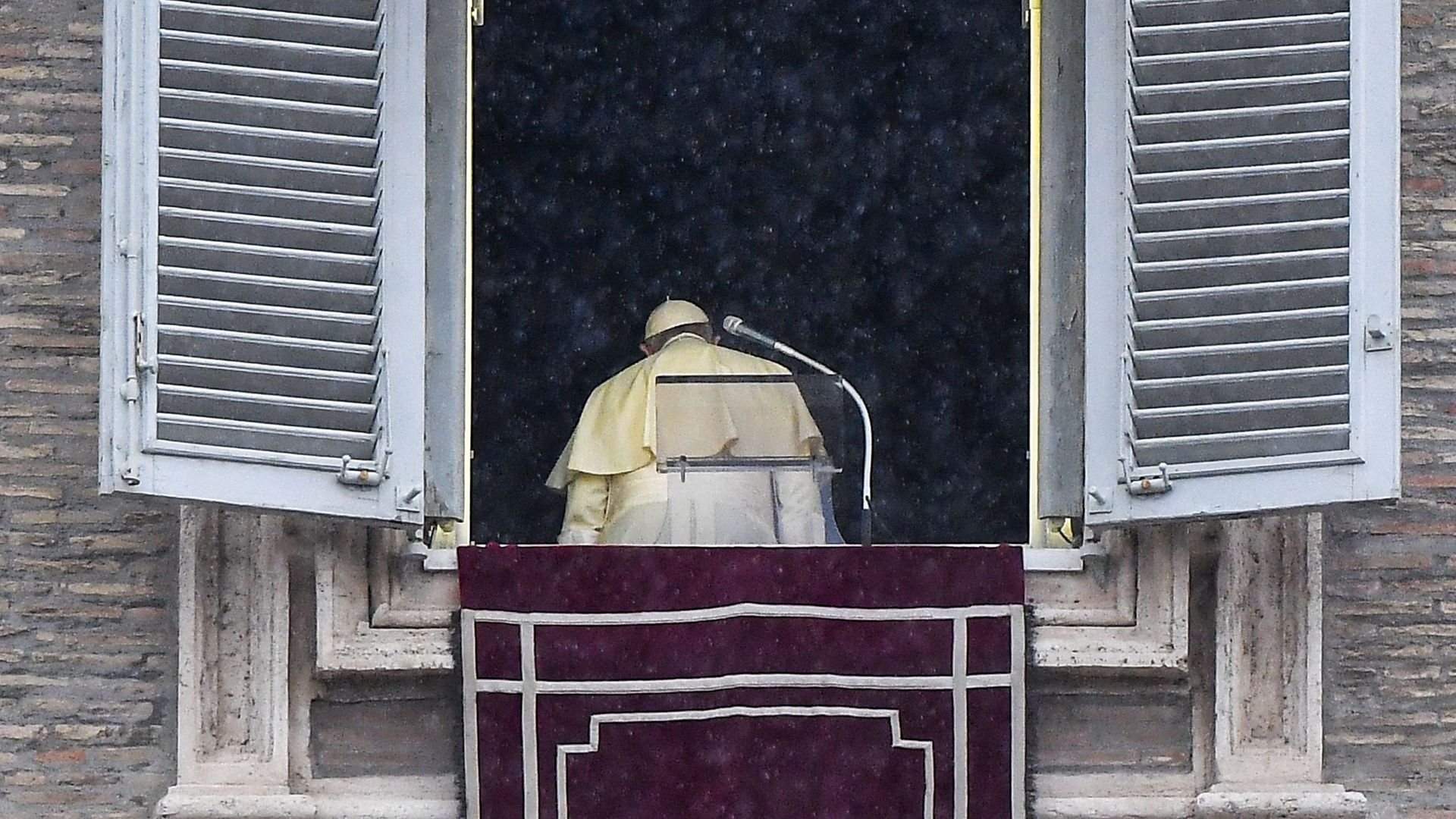 | | | Pope Francis following prayers in St. Peter's Square. Photo: Tiziana Fabi/AFP via Getty Images | | | | Secretary of State Mike Pompeo will visit the Vatican tomorrow to protest the pending renewal of a deal with China. Behind the scenes: Pope Francis has reportedly declined to meet with Pompeo, citing the imminent U.S. election. - Francis already has plenty on his plate. He removed a senior cardinal who had been viewed as a potential future pope last week over claims he embezzled Church funds, per AP.
The big picture: The terms of the deal with Beijing are secret, but it reportedly gives the Vatican a say in the appointment of bishops in the government-sanctioned Church in China. It's controversial for multiple reasons. - Some critics argued that cutting a deal with the Chinese government meant selling out the many Chinese Catholics who take the risk of worshipping in non-sanctioned churches.
- Others including Pompeo contend that in order to facilitate stronger ties with China, the Church has declined to take a strong stand against China's human rights abuses.
- "The Vatican endangers its moral authority, should it renew the deal," Pompeo tweeted earlier this month.
Between the lines: It's highly unusual for a senior U.S. official to criticize the pope so forcefully. | | | | | | | | 5. Interview: Albright on America's global role | 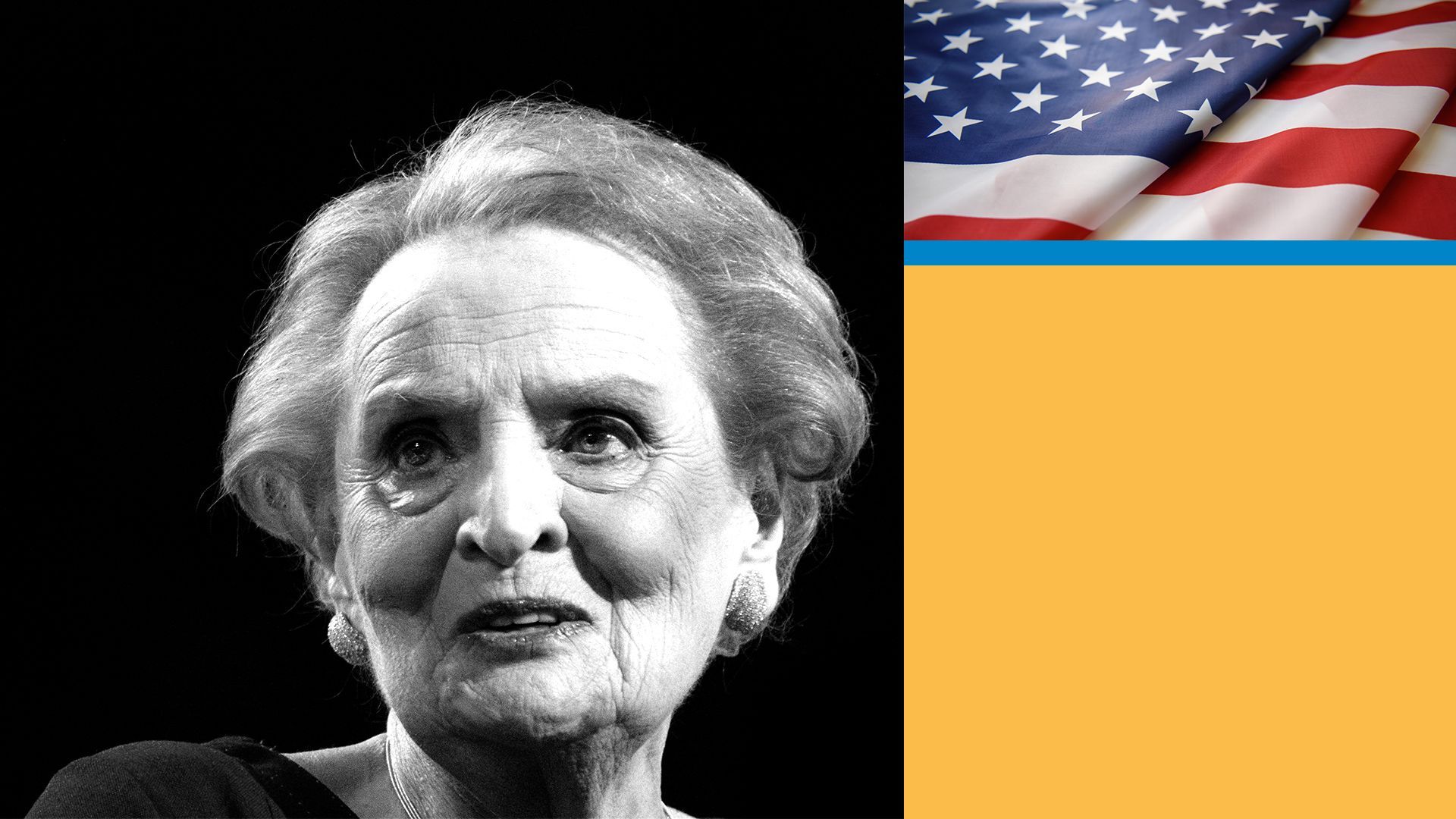 | | | Photo Illustration: Axios Visuals. Getty Images photos: Benjamin Lowy | | | | "I'm disappointed," Madeleine Albright says when asked about the lack of collective action on the pandemic, including at the United Nations this week. "Am I surprised? No." What she's saying: "Given the kind of atmosphere that is out there by virtue of America's lack of interest — more than lack of interest, undermining — of an international system, it's hard." Albright represented the U.S. as ambassador to the U.N. (1993-1997) and as secretary of state (1997-2001) when American power was near its apex. - She says that power is still there to be exerted to spur global action on issues like the pandemic, climate change and nuclear proliferation.
- "There is nothing better than representing the United States, but you have to decide how you are going to use that power in terms of getting others to cooperate and be a part of a common solution."
The other side: President Trump made much the opposite argument in his address to the General Assembly, contending that the world would be better off if countries followed his lead and focused on their own populations. - Albright, who has endorsed Joe Biden, contends that there's still time for a course correction — but that if Trump is reelected, the "U.S.-led" global system may be impossible to put back together.
- "Another four years of this, and it really is going to be increasingly difficult to persuade anybody that we are going to be dependable partners," she says.
Her bottom line: "After a while, I think people will say, 'If you don't want to be a partner, then go do your thing and we'll do ours.'" | | | | | | | | 6. What I'm listening to: "The Deal" |  | | | Illustration: Aïda Amer/Axios | | | | The fate of the Iran nuclear deal could well be decided by November's election — if the deal even survives to January's inauguration day. Now a new podcast, "The Deal," explores how it all came together in the first place. It's hosted by nukes expert Jeffrey Lewis. - The first three episodes have focused on the discovery of Iran's secret nuclear program, the launch of backchannel talks, and the entry of top nuclear scientists into the negotiations.
- Lewis has promised future episodes taking in the opposition to the deal — which Trump withdrew the U.S. from in 2018 — and its uncertain future.
What to watch: This issue will be coming to a head regardless of what happens in November. - The deal was intended to keep Iran's nuclear "breakout time" over one year, but it's now down to an estimated 3-6 months.
- If Biden gets in, he'll find it difficult to convince Iran to return to compliance and extend its commitments beyond the current sunsets.
- If Trump is reelected and the deal falls apart, it's unclear what a second term of "maximum pressure" might lead to.
| | | | | | | | 7. Stories we're watching | 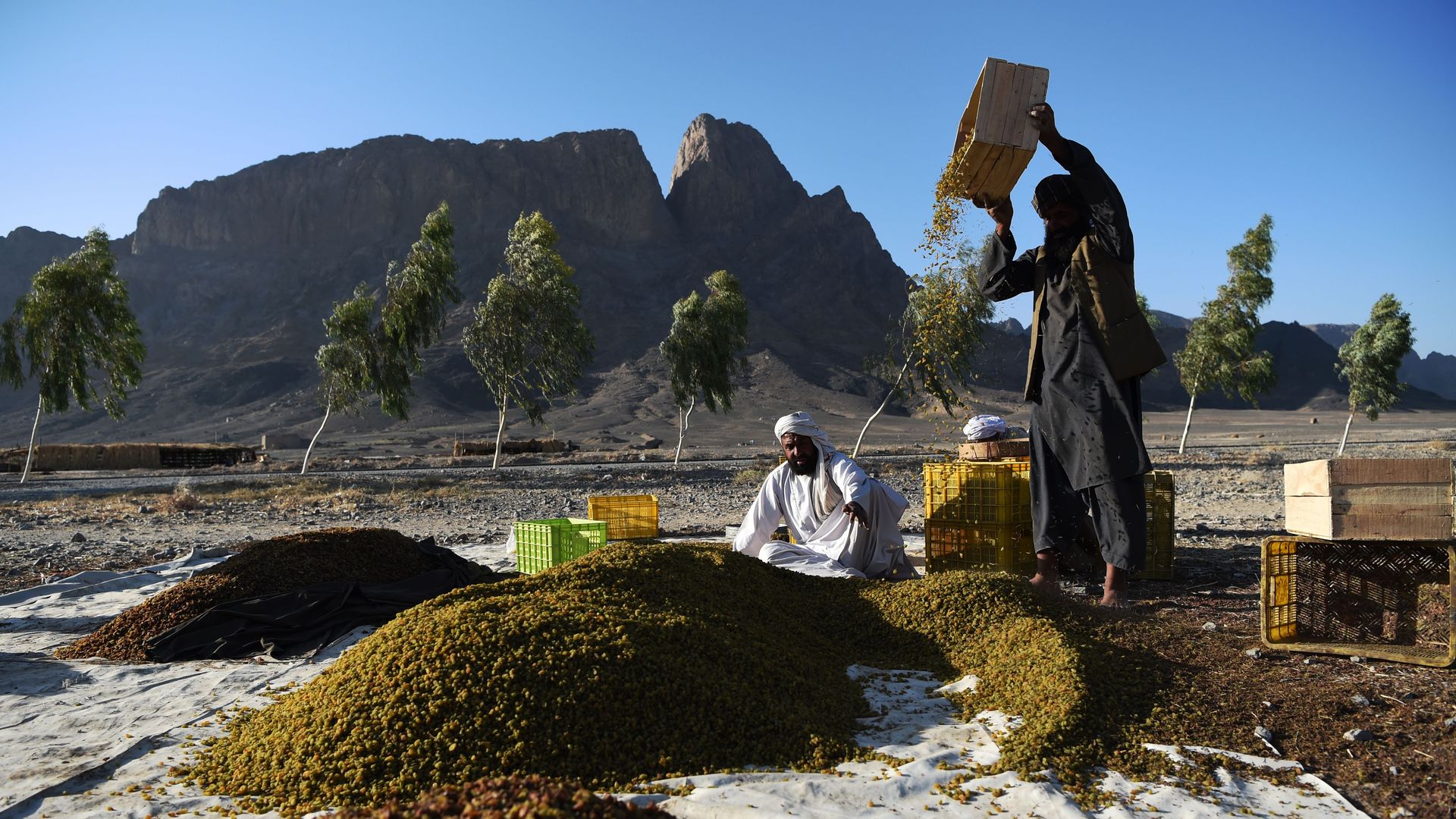 | | | Sorting raisins in Afghanistan. Photo: Wakil Kohsar/AFP via Getty Images | | | - Special report: Hinge moment for America's global role
- What China wants from the global system
- U.S. and U.K. team up on AI
- Kim Jong-un apologizes over killing of South Korean official
- Putin proposes non-interference pact with U.S.
- Abbas calls for Israel-Palestine conference after election
- Japanese PM vows to hold Olympics in '21
Quoted: "I am very grateful to Chancellor Merkel for visiting me in hospital." — Alexei Navalny, the poisoned Kremlin critic, on a high-profile visitor today. | | | | | | | | A message from the Carnegie Endowment for International Peace | | Asia is about more than just U.S.-China | | | | | | | | Beijing and Washington are fighting to set the rules in Asia. But other Asian countries are making a patchwork of their own rules, standards, and norms. Evan Feigenbaum explains how Asia's future is not Washington's or Beijing's to determine. Find out his thoughts on the future of the region. | | | | | | Axios thanks our partners for supporting our newsletters.
Sponsorship has no influence on editorial content. Axios, 3100 Clarendon Blvd, Suite 1300, Arlington VA 22201 | | | You received this email because you signed up for newsletters from Axios.
Change your preferences or unsubscribe here. | | | Was this email forwarded to you?
Sign up now to get Axios in your inbox. | | | | Follow Axios on social media:    | | | | | |


 اللباس التقليدي الحضرمي للرجال مرحبا بكم في سلسلة اللباس التقليدي الحضرمي .. لنتعرف معا على تراثنا ...وربما أن بعض هذه الملابس لم تعد مس...
 شغل الشاعر سعيد فرج باحريز رحمه الله الناس في المكلا وحضرموت عموماً باشعاره التي كانت لها مدلولات عميقة وثاقبة ومعانٍ بليغة وحكيم...

