| | | | | | | Presented By PhRMA | | | | Vitals | | By Caitlin Owens ·Sep 29, 2020 | | Good morning. If you'd like to entertain me today, please send your debate Bingo cards. Today's word count is 1,071, or a 4-minute read. | | | | | | 1 big thing: Joe Biden's plan to make the ACA more affordable | 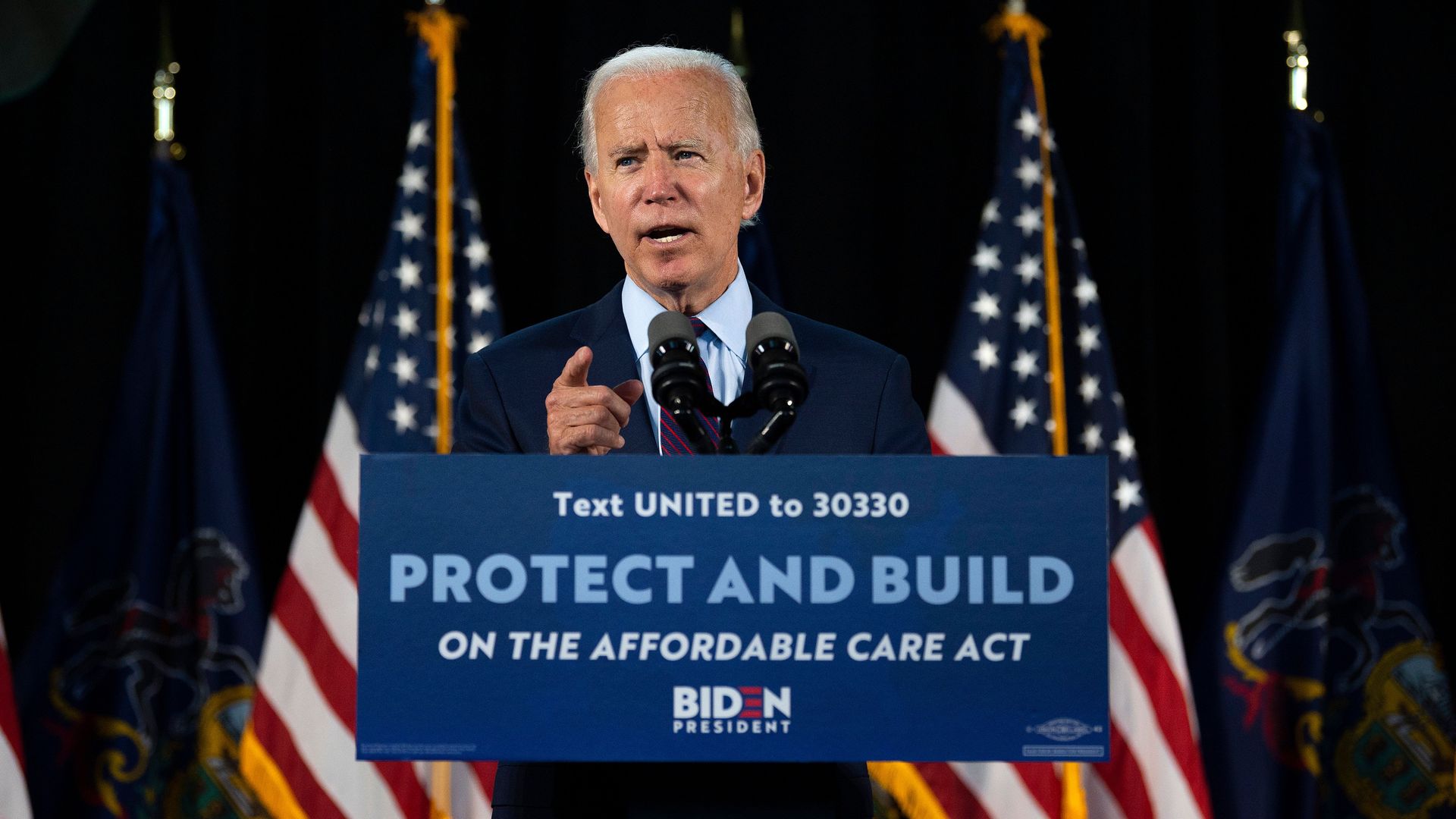 | | | Joe Biden speaks at an event about affordable health care. Photo: Jim Watson/AFP via Getty Images | | | | Tonight is the first debate between Joe Biden and President Trump, and one thing that is sure to come up is health care. - A timely new Kaiser Family Foundation analysis found that Biden's proposal to increase Affordable Care Act subsidies and open the marketplace to people with employer insurance could save millions of people hundreds of dollars a month.
Why it matters: Biden's plan to build on the ACA — making it more affordable and drawing more people onto its exchanges — sets up a stark contrast with President Trump's vision, which is to tear the entire law down. The big picture: Expanding ACA subsidies could enormously benefit middle-class people — particularly older people who live in more rural areas — who don't qualify for subsidies and so spend a large portion of their income on premiums each month. - It could also be helpful for people who spend a lot on employer insurance, but are barred from choosing a subsidized plan on the individual market.
Driving the news: Affordable coverage options have become even more important during the pandemic, as millions of Americans lose their jobs and their insurance. - Employers looking to reduce expenses are increasingly opting out of providing health coverage, a problem that is likely to get worse, NYT reported yesterday.
By the numbers: Biden has proposed to limit what anyone pays in premiums to 8.5% of their income, and to change the way subsidies are calculated. - This would lower the cost of coverage for nearly everyone who is already enrolled in an ACA plan, as well as for those who can't afford this coverage, per KFF.
- More than 12 million people with employer insurance would spend less on premiums if they switched to an ACA plan subject to premium caps.
Yes, but: The plan would cost an estimated $750 billion over 10 years — a hefty price tag. |     | | | | | | 2. 1 million deaths worldwide |  Data: Our World in Data; Chart: Sara Wise/Axios The global toll of confirmed deaths from COVID-19 crossed 1 million on Monday, according to data from Johns Hopkins. By the numbers: More than half of those deaths have come in four countries: the U.S. (204,995), Brazil (141,741), India (95,542) and Mexico (76,430). The true global death toll is likely far higher, Axios' Dave Lawler reports. How we got to 1 million: The first known death from COVID-19 was announced on Jan. 11 in Wuhan, China, where the pandemic began. - Europe became a new epicenter by early March. The highest daily global death tolls came in mid-April when the pandemic was near its peak in western Europe and in parts of the U.S., including New York City.
- By early May, the situation was improving in Europe but the U.S. continued to record upward of 1,000 deaths each day. Latin America, meanwhile, was becoming a new global epicenter.
- Since the spring, more than half of all deaths recorded globally have come in the Americas.
The true death toll from COVID-19 will never be known with any precision, but "excess mortality" figures indicate that the U.S. is probably undercounting deaths by about 30% — and many other countries by more than that, per the Economist. - Mike Ryan, emergencies director at the WHO, recently warned that the official death toll could double to 2 million before a vaccine is widely available.
| | | | | | | | 3. Americans won't take Trump's word on the vaccine |  Data: Axios/Ipsos survey; Note: Margin of error for the total sample is ±3.2%; Chart: Axios Visuals Barely two in 10 Americans would take a first-generation coronavirus vaccine if President Trump told them it was safe — one of several new measures of his sinking credibility in the latest wave of the Axios-Ipsos Coronavirus Index. Details: Given eight scenarios and asked how likely they were to try the vaccine in each case, respondents said they'd be most inclined if their doctor vouched for its safety (62%), followed by insurance covering the full cost (56%) or the FDA saying it's safe (54%), Axios' Margaret Talev writes. - Acting on Trump's assurances came in dead last as an option (19%).
- People said they'd be more likely to take it if they had to pay $100 out of pocket or visit a hospital to get it.
The big picture: With just five weeks left in the election, Week 26 of our national survey offers additional signs that trust in the president and his administration are continuing to fall over the handling of the pandemic. - Just 32% said they trust the federal government to provide them with accurate information about COVID-19, down four percentage points from a week ago and a new low for the index.
- Trust in the White House fell to 28%, and trust in Trump himself fell to 27% — also new lows.
- Trust in Joe Biden is higher, but not exactly a vote of confidence: 47% of respondents said they trust him, consistent with past weeks.
Go deeper. | | | | | | | | A message from PhRMA | | Biopharmaceutical science fights against COVID-19 | | |  | | | | The biopharmaceutical industry is leading the way in developing new vaccines and treatments for COVID-19. The background: Biopharma companies across the U.S. are committed to developing solutions to help diagnose, treat and prevent the coronavirus. Find out more from the video. | | | | | | 4. Trump announces rapid test distribution | | President Trump announced on Monday that the federal government will distribute 150 million rapid, point-of-care coronavirus tests to states over the next few weeks, including to K–12 schools and vulnerable communities like nursing homes and assisted living facilities. Why it matters: The Trump administration has stressed the importance of reopening schools in allowing parents to return to work and jumpstarting the economy, Axios' Marisa Fernandez writes. What's happening: Who gets tested is ultimately at the discretion of the governors, but the administration is encouraging schools to use the rapid tests to help restart and maintain in-person teaching. - The rapid tests, which deliver results in 15 minutes, will come from a previously announced supply of 150 million tests ordered from Abbott Laboratories. Teachers and parents would be able to test their children on a weekly basis.
- 6.5 million tests will go out this week and a total of 100 million tests will be distributed to governors based on state population over the next several weeks, Trump announced.
What they're saying: "The number of tests being made available not close to what's needed for routine testing like they described," Johns Hopkins' Jennifer Nuzzo tweeted. - "Don't get me wrong, these rapid tests can and will likely be crucial to control this virus. But the math here just doesn't add up," epidemiologist Michael Mina tweeted. "This is not near the type of rapid test volume that is needed to make a major impact."
| | | | | | | | 5. Catch up quick |  | | | Illustration: Aïda Amer/Axios | | | | Speaker Nancy Pelosi (D-Calif.) on Monday unveiled House Democrats' new $2.2 trillion coronavirus relief proposal. India became on Monday the second country after the U.S. to surpass 6 million cases. NIAID director Anthony Fauci told CNN Monday that "some of the things" Fox News reports about the coronavirus "are outlandish." New peril for employers: Wrongful death "take home" lawsuits from the coronavirus, using the prior examples of asbestos. New York Gov. Andrew Cuomo (D) announced Monday the state will extend its moratorium on coronavirus-related evictions until Jan. 1, 2021. | | | | | | | | A message from PhRMA | | Biopharma is progressing in the fight to beat COVID-19 | | |  | | | | Biopharmaceutical companies across the country are collaborating in new ways to help defeat the coronavirus. The results: In a matter of weeks they've gone from potential treatments to antibodies and antivirals that have shown positive results. See how science can help us get back to normal. | | | | | | Axios thanks our partners for supporting our newsletters.
Sponsorship has no influence on editorial content. Axios, 3100 Clarendon Blvd, Suite 1300, Arlington VA 22201 | | | You received this email because you signed up for newsletters from Axios.
Change your preferences or unsubscribe here. | | | Was this email forwarded to you?
Sign up now to get Axios in your inbox. | | | | Follow Axios on social media:    | | | | | |


 اللباس التقليدي الحضرمي للرجال مرحبا بكم في سلسلة اللباس التقليدي الحضرمي .. لنتعرف معا على تراثنا ...وربما أن بعض هذه الملابس لم تعد مس...
 شغل الشاعر سعيد فرج باحريز رحمه الله الناس في المكلا وحضرموت عموماً باشعاره التي كانت لها مدلولات عميقة وثاقبة ومعانٍ بليغة وحكيم...

