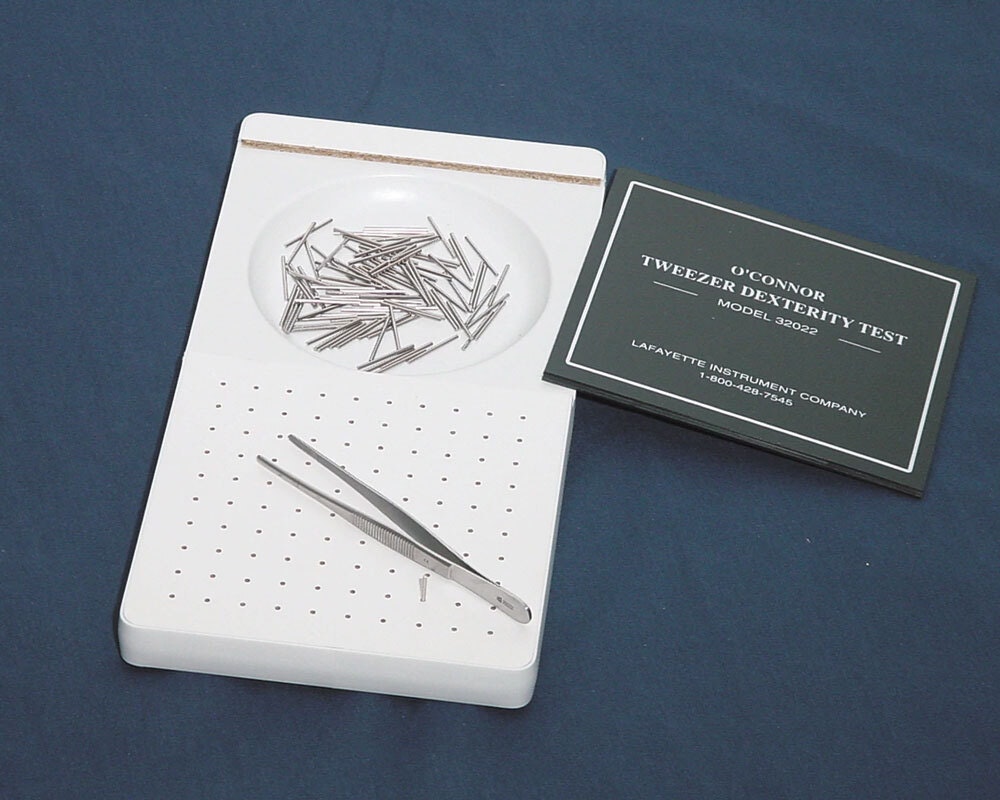
The O'Connor Tweezer Dexterity Test, which sells on Amazon for a shockingly expensive $160+, is a test of precision and manual aptitude that relies on placing a series of pins into specific holes on a board. The test is fairly simple and a good way to measure whether a person is handy with handling small, precise things with their hands. (Check out a video of someone doing it, above. IMPORTANT EDITORIAL NOTE: DO NOT SEARCH ON YOUTUBE FOR TWEEZERS. IT IS GROSS.)
Its inventor, Johnson O'Connor, had a knack for developing things like this, first through an in-house position at General Electric in the 1920s in which he developed a series of skills tests, including the dexterity test, which first found use among GE's 3,000 employees. The tests, 17 in total, weren't specifically tied to physical tests; they also emphasized things such as clerical ability, personality, observation, number memory, and visual imagination. (As noted in his 1973 New York Times obit, he also found a niche in vocabulary building.)
While these concepts were first built for corporate America, they soon found homes in academia (they were further developed at the Massachusetts Institute of Technology and Stevens institute of Technology) and in the form of a nonprofit that still exists today, the Johnson O'Connor Research Foundation.
Know Your Real Abilities: Understanding and Developing Your Aptitudes, a 1948 book partly inspired by O'Connor's work by Charles V. And Margaret E. Broadley, put the reasoning for the approach as such:
Most of us want work in which we can put our hearts, in which we feel we are making some contribution to the world. But we see no way out in our modern world where so many jobs are routine, where individual development has been pushed aside to make way for material progress. Yet we sense vaguely that we have more in us; we feel restless and dissatisfied with ourselves; we feel inferior and inadequate. But we do not know what to do about it.
This mindset about work abilities helping to define whether a person is a match for the field they're in is a driving force behind the nonprofit that bears Johnson's name.
"Aptitude testing is the starting place to identify strengths," said Alina Myers, director of Johnson O'Connor Research Foundation Inc. in Washington, a nonprofit educational organization founded nearly 70 years ago. "Aptitudes don't change over time."
And obviously, there are lots of fields where the ability to use a tweezer in this way can come in handy. For example, electrical engineering, a field for which soldering is a key skill set; for another, surgery, where precise movements are often necessary. And this test, beyond its value for aptitude testing, is also a great option for rehabilitation, for those trying to improve dexterity after an injury.
You might laugh at the idea of taking a bunch of random tests to understand your skill sets, but these tests are vigorous, and apparently take a lot out of the people who do them.
"Trials they were. I dropped the tweezers. Whole sequences of numbers, once shown, were promptly forgotten," one person wrote in a testimonial. "A vocabulary test left my smug self-assurance as an erudite man of letters in shambles. First I felt challenged, then frustrated, and, in the end, exhausted."
(That person was pinned as a communicator, which makes sense, because as we all know, communicators can't tweeze.)










.jpg%3Futm_source=Tedium%26utm_campaign=Tedium_09_29_2020%26utm_medium=email/1/01000174dee716d3-17a8c4c3-20be-42c4-8b28-22dcfa36c230-000000/JQRLe1vthIVCi-t-nkPAXmhlAhg=181)