| | | | | | | Presented By Chevron | | | | Generate | | By Ben Geman ·Sep 29, 2020 | | Good morning. Today's Smart Brevity count: 1,167 words, 4 minutes. Breaking Tuesday: "Swedish lithium-ion battery maker Northvolt is raising $600 million in fresh equity through a private placement with Volkswagen, Baillie Gifford, Goldman Sachs and Spotify founder Daniel Ek among the investors." (Reuters) Last week marked 49 years since T. Rex released "Electric Warrior," and tomorrow is the late Marc Bolan's birthday, so they've got today's absolutely killer intro tune... | | | | | | 1 big thing: EPA vs. California's new EV mandate | | Giphy EPA is making its opening moves against California's plan to phase out sales of new gasoline-powered cars by 2035 — the latest front in the battle between the White House and the state over climate policy. Driving the news: Via The Wall Street Journal, EPA boss Andrew Wheeler sent California Gov. Gavin Newsom a letter attacking the plan and arguing it would require EPA approval. The letter Monday says there are "serious questions" about the plan's legality and that it may require a waiver from EPA, per Reuters' report on it. Why it matters: California is the nation's largest auto market. Newsom's plan last week is the most aggressive U.S. move to curb carbon emissions from transportation and push electric vehicles. - Wheeler's letter underscores the stakes of the ongoing litigation between EPA and California over cars, as well as the outcome of the election, and even the Supreme Court makeup.
- Last year the Trump administration revoked the state's special authority under the Clean Air Act to set its own tailpipe emissions rules that a number of other states may adopt.
Yes, but: The fight over California's plan is in its early stages. Newsom's executive order last week is only a first step. State regulators' completion of final rules to actually implement it is likely years away. The intrigue: It's a legal fight, but also a PR battle, with Wheeler's letter taking aim at California's recent rolling blackouts. - The states' power woes raise the question of "how you expect to run an electric car fleet that will come with significant increases in electricity demand, when you can't even keep the lights on today," it states.
- Newsom spokesman Jesse Melgar, in a statement to several outlets, said the Trump administration is trying to "drive this country off a climate cliff."
- "We aren't going to back down from protecting our kids' health and the air they breathe," he said.
|     | | | | | | Bonus: The long road to EV dominance |  For advocates of electric cars and cutting carbon emissions, that chart could be viewed as encouraging, daunting, or both. The big picture: Per DOE's handy transportation "fact of the week" series, it shows how EV sales have taken off over the last decade. And full electrics have overtaken plug-in hybrids over the last five years. Why it matters: EVs are growing, but still represent a tiny share of the roughly 17 million-plus passenger vehicles sold annually in the U.S. (a number dropping this year because of the pandemic). Even in California, the biggest EV market, cars with a plug were around 8% of new sales last year. What we're watching: The angle of that upward line. Joe Biden, if he wins, hopes to juice EV sales with investments in charging infrastructure and expanded vehicle tax credits (among other things). Automakers, for their part, are bringing a suite of new models to market, and as noted in the item above, the fate of state efforts will matter too. Go deeper: Eyeing the end of gas-powered cars | | | | | | | | 2. The Democrats' energy puzzle | 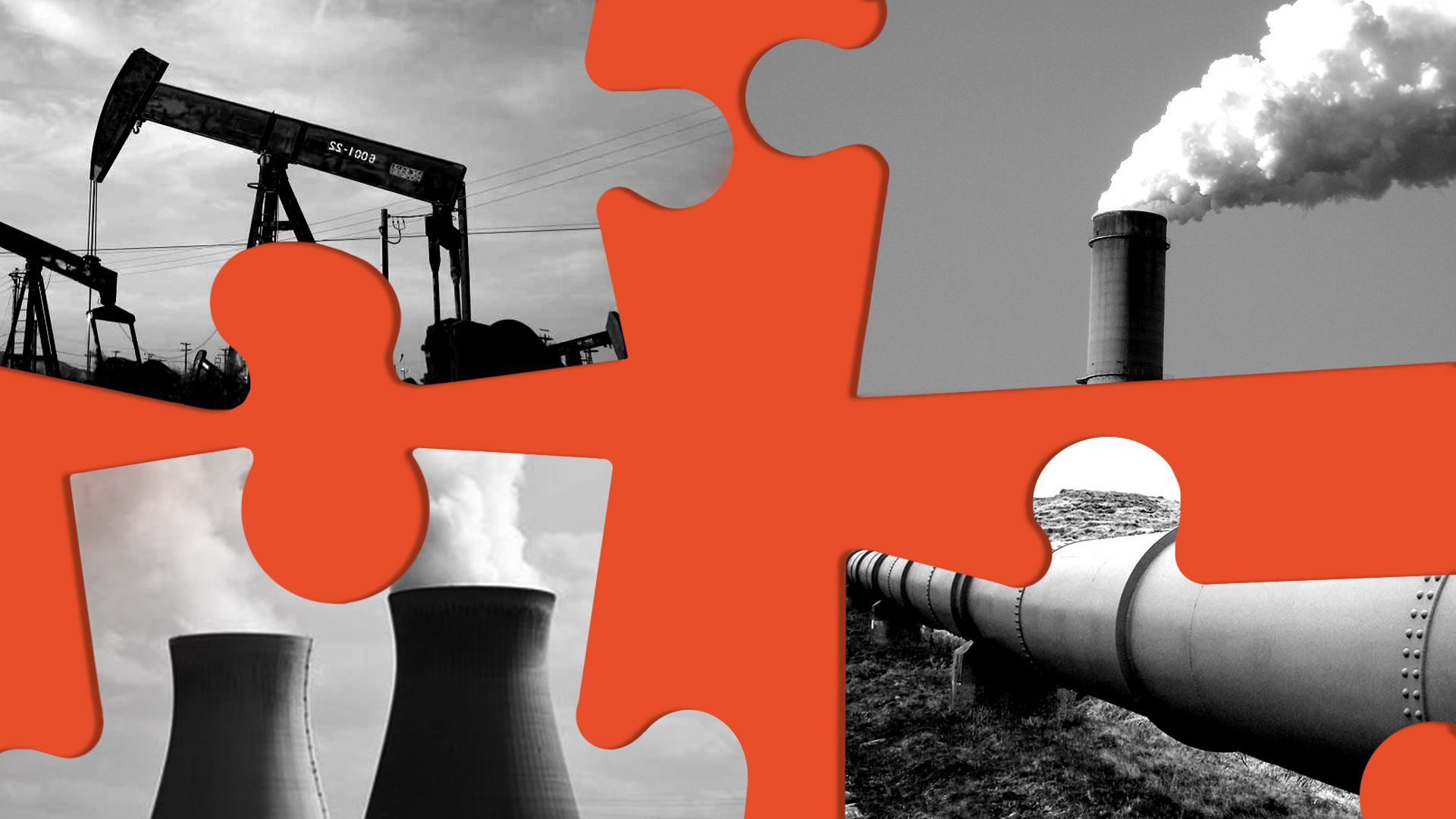 | | | Illustration: Rebecca Zisser/Axios | | | | The AFL-CIO, a key part of the Democratic coalition, says it wants to go big on climate change. But its policy goals don't always line up with other parts of the left. Driving the news: The labor federation and the nonprofit Energy Futures Initiative yesterday unveiled a "framework for good jobs in a low-carbon future." - The 10 pillars of the plan have plenty of things that labor and climate activists agree on.
- Think, for instance, bolstering the domestic offshore wind supply chain; expanded investments in building efficiency; and policy reforms to build out the transmission needed to bring renewables to urban areas.
Yes, but: Some aspects of the plan won't sit especially well with the left flank of the green movement (I put it that way because climate activists have a wide range of views). - It sees a substantial continuing role for natural gas in ways "consistent with meeting climate goals." But many activists are pushing to phase down gas production and use as quickly as possible.
- More broadly, it makes the case for more aggressive efforts to develop and deploy carbon capture, utilization, and sequestration technologies.
- It makes several arguments for the tech, which faces skepticism and even hostility among some activists who oppose fossil fuels.
- For instance, it calls it a needed to decarbonize high-emitting industries like steel, pulp and paper, cement and more.
Go deeper: The Washington Examiner has more on the plan from the AFL-CIO and EFI, which is led by Obama-era energy secretary Ernest Moniz. And AFL-CIO head Richard Trumka and Moniz discuss the report on the new episode of the Columbia Energy Exchange podcast. | | | | | | | | A message from Chevron | | Chevron is investing in CO2 capture and storage | | |  | | | | We're taking action to address CO2 emissions by reducing the carbon intensity of our operations. We've spent over $1 billion building one of the world's largest integrated carbon capture and storage facilities, capable of capturing up to 4 million tons a year. Learn more. | | | | | | 3. Off-roading is going electric |  | | | In the future, Polaris will offer electric powertrains across its lineup of snowmobiles and off-road vehicles. (Pictured is a current model, which doesn't represent the future product.) Photo credit: Polaris Inc. | | | | Polaris plans to electrify its popular lineup of off-road vehicles and snowmobiles through a new 10-year technology partnership with Zero Motorcycles, Axios' Joann Muller reports. Why it matters: People who want to enjoy the Great Outdoors don't have to worry about polluting the environment or disturbing the wilderness when they're riding on a nearly-silent, zero-emission machine. Details: Under the exclusive agreement, Polaris will develop, manufacture and sell electrified off-road vehicles and snowmobiles using Zero's powertrain technology, hardware and software. - The company will offer an electric vehicle option within each of its core product segments by 2025, the first of which will debut by the end of 2021.
- It includes Polaris' Ranger, Razor and General side-by-side vehicles, as well as its all-terrain ride-on vehicles (ATVs) and snowmobiles.
Between the lines: In an interview with Axios, Polaris CEO Scott Wine acknowledged he was an "extremely reluctant" convert to electric powersports, because the company could never find the right balance of cost, performance, weight and range. But EV technology has improved, and Zero Motorcycles, which has been designing and manufacturing electric motorcycles since 2006, is the right partner, he said. Go deeper | | | | | | | | 4. Chart of the day: A new shale giant |  Data: IHS Markit; Chart: Andrew Witherspoon/Axios The merger of Devon Energy and WPX Energy, assuming the deal announced yesterday goes through, will create one of the largest onshore oil producers in the U.S. The big picture: The data above looks at how the combined company's unconventional oil and condensate production stacks up against other shale players. Also, note the output from Chevron once it completes the acquisition of Noble Energy. Of note: The data courtesy of IHS Markit looks at gross operated production — that is, volumes that include oil owned by well partners and holders of subsurface mineral rights. But it lines up with other tallies. Per the Financial Times, they'll be the fourth-largest U.S. shale producer by output. | | | | | | | | 5. Coastal drilling battle hits wind too | | Bloomberg reports: "President Donald Trump's decision to rule out energy development along the coasts of Florida, Georgia and the Carolinas will bar not just offshore oil and gas drilling — but coastal wind farms too." Why it matters: The story gets to the unexpected bank-shot effects of the political battles over offshore fossil fuel development. Deep-pocketed wind power developers are planning a suite of projects off the northeast but now face new restrictions further south as a result of White House policies. What's new: In addition to adding North Carolina's coast to areas the Trump administration has backed off plans to lease to oil companies, Trump said Friday Virginia will be added too. Yes, but: "Existing offshore energy leases are not set to be affected by the orders, including existing wind farm rights off the coasts of Virginia and North Carolina," Bloomberg notes. But the story warns the White House policies could imperil future proposals, including off South Carolina's coast. | | | | | | | | A message from Chevron | | Chevron is investing in CO2 capture and storage | | | | | | | | We're taking action to address CO2 emissions by reducing the carbon intensity of our operations. We've spent over $1 billion building one of the world's largest integrated carbon capture and storage facilities, capable of capturing up to 4 million tons a year. Learn more. | | | | | | Axios thanks our partners for supporting our newsletters.
Sponsorship has no influence on editorial content. Axios, 3100 Clarendon Blvd, Suite 1300, Arlington VA 22201 | | | You received this email because you signed up for newsletters from Axios.
Change your preferences or unsubscribe here. | | | Was this email forwarded to you?
Sign up now to get Axios in your inbox. | | | | Follow Axios on social media:    | | | | | |